Key Takeaways
- In-plane graphite hits ~2,000 W/m·K, roughly 5x copper's ~400 W/m·K (Electronics Cooling, 2019).
- Through-plane conductivity sits near 6 W/m·K, about 300x lower than in-plane (Pierson, Handbook of Carbon, Graphite, Diamond and Fullerenes, 1994).
- Graphene, graphite's single-layer cousin, reaches ~5,000 W/m·K, roughly 13x copper (Graphene Heat Spreaders Market Research Report, 2025).
- The pyrolytic graphite sheet market is growing at a 12-16% CAGR through 2035, driven by EV and AI cooling demand (IndexBox, 2026).
Is Graphite a Good Conductor of Heat, In Short?
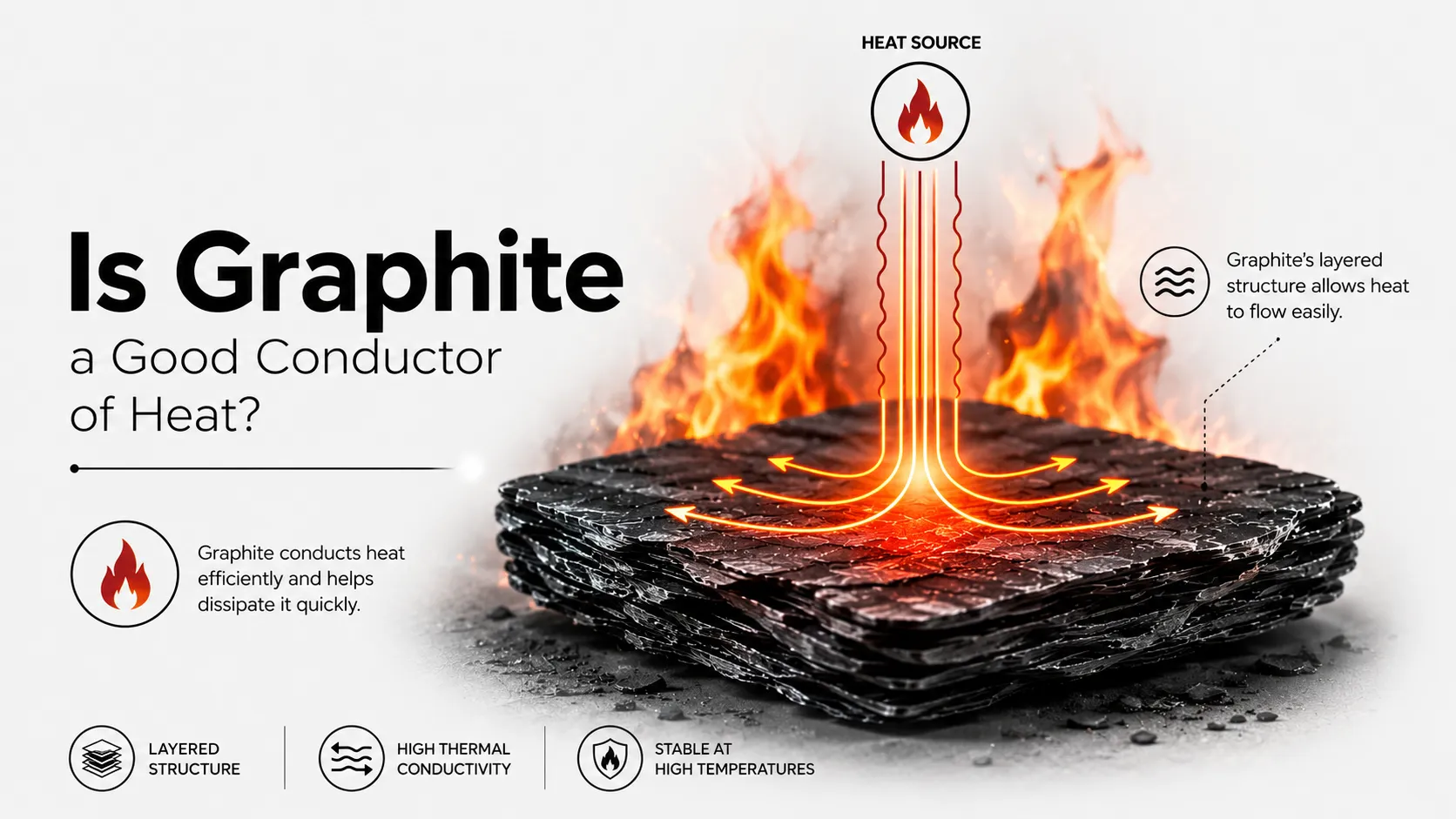
Yes, in one direction. Graphite's basal-plane thermal conductivity reaches approximately 2,000 W/mK in single crystal graphite, a figure high enough to outperform nearly every metal used in electronics cooling. That number is why "graphite sheet" and "heat spreader" are basically synonyms in a modern smartphone teardown.
The catch is direction. Graphite is a stack of two-dimensional carbon sheets, and the most familiar example of anisotropic thermal transport is graphite, with an exceptional thermal conductivity of 2000 W/mK in the basal plane but only 6 W/mK in the cross-plane. So "is graphite a good conductor" really depends on whether heat is trying to travel across the sheet or through the stack.
Isn't that inconsistency a design headache? For most cooling applications, no — engineers deliberately orient the sheet so heat travels in-plane, turning the weakness into a feature that spreads hotspots sideways instead of letting them build up vertically.
Internal link: how heat sinks work → link to a guide on heat sink materials and design
Why Is Graphite's Thermal Conductivity So Anisotropic?
The anisotropy traces straight back to the chemical bond. Graphite's exceptional in-plane conductivity and poor cross-plane conductivity is the most familiar example of anisotropic thermal transport in layered crystals, and the mechanism is worth understanding before spec'ing the material.
Within a single graphite sheet, carbon atoms are locked together by strong covalent bonds arranged in a hexagonal lattice — the same bonding pattern found in graphene. Those bonds let phonons, the vibrational packets that carry heat through a solid, travel long distances with little scattering. That's the physical basis of the ~2,000 W/m·K figure.
Between sheets, the story flips completely. The layered anisotropic crystal structure means graphite can possess extreme values of thermal conductivity that are difficult to achieve in isotropic solids, because adjacent planes are held together only by weak van der Waals forces. Phonons crossing that gap scatter constantly, which is why through-plane conductivity drops to single digits.
Recent materials science hasn't left through-plane conductivity alone, either. A 2025 study found that graphite delivers a record high through-plane thermal conductivity of up to 13.4 W m−1 K−1 at room temperature when the structure is optimized, achieved by reducing the helical twist within the graphite structure. That's still nowhere near in-plane performance, but it roughly doubles what was previously considered graphite's ceiling in that direction.
Internal link: phonon transport basics → link to an explainer on how heat moves through solids
How Does Graphite Compare to Copper, Diamond, and Graphene?
Graphite beats copper and aluminum outright in-plane, but it isn't the top performer in the carbon family. Graphene possesses a superior in-plane thermal conductivity up to 5,300 W/m·K at room temperature, far higher than copper's 402 W/m·K and aluminum's 237 W/m·K. Independent measurements broadly agree: the measured thermal conductivity of graphene is in the range 3,000-5,000 W/mK at room temperature, compared with pyrolytic graphite at approximately 2,000 W/mK.
Diamond sits in between graphite and graphene on paper but wins on isotropy. Diamond's thermal conductivity of 1,000-2,200 W/mK makes it 2.5 to 5.5 times faster than copper, and unlike graphite, it conducts that well in every direction. That's why engineers spec diamond for die protection and electrical isolation in high-power modules where hotspots can't be tolerated, even though it costs far more than copper.
So why not just use graphene or diamond everywhere? Cost and manufacturability. Diamond heat spreaders run 50 to 100 times pricier than copper per square centimeter, and free-standing graphene is fragile and near-impossible to bond practically at scale. Graphite hits a sweet spot: strong enough conductivity, thin and flexible, and cheap enough to laminate into a billion phones a year.
| Material | In-plane conductivity | Notes |
|---|---|---|
| Graphene | ~3,000-5,300 W/m·K | Best performance, hardest to manufacture at scale |
| Diamond | ~1,000-2,200 W/m·K | Isotropic, electrically insulating, expensive |
| Graphite (pyrolytic) | ~1,500-2,000 W/m·K | Thin, flexible, cost-effective, anisotropic |
| Copper | ~400 W/m·K | Standard baseline, isotropic |
| Aluminum | ~237 W/m·K | Lightweight, lower cost, lower performance |
Where Engineers Actually Use Graphite's Heat Conduction
Smartphones are the clearest example. Synthetic pyrolytic graphite sheets act as the core passive cooling solution in modern smartphones, spreading the joule heating generated by high-frequency SoCs, 5G modules, and fast-charging circuits across a much larger surface area. Because active cooling solutions like fans are unfeasible in a phone chassis, the graphite sheet's in-plane conductivity does the entire job of turning a small hotspot into a manageable, evenly distributed temperature.
The mechanism is simple once you see it applied. Heat generated by a phone's processor gets delivered to the shell, frame, and touch screen through the graphite sheet so the effective heat dissipation area is enlarged, which is also how manufacturers solve the problem of a device getting too hot to hold during long use.
Electric vehicles are next in line. Battery packs increasingly use a thermal pyrolytic graphite spreader sandwiched between an aluminum base plate and the battery cell, rapidly conducting and spreading cell heat to the cooling medium. That improves cell temperature uniformity and reduces both max cell temperature and max differential temperature, directly improving battery durability.
Demand reflects it. The pyrolytic graphite sheet market is projected to grow at a compound annual rate of 12-16% through 2035, underpinned by thermal management requirements of high-power electronics, EV battery systems, and aerospace platforms. Separately, the broader graphite sheet market was valued at $3.07 billion in 2024 and is projected to reach $3.89 billion by 2032, with EV manufacturers increasingly adopting graphite sheets for battery thermal management as global EV sales grow at roughly 25% annually.
Internal link: EV battery cooling systems → link to a deep dive on battery thermal management design
What Are Graphite's Limits as a Thermal Conductor?
The anisotropy that makes graphite useful also makes it tricky to engineer around. If a design needs heat to move vertically — say, from a chip die straight down through a stack to a cold plate — a graphite sheet oriented the wrong way barely helps at all, since the through-plane direction of these sheets is no greater than about 12 W/m°K in typical implementations.
Manufacturing adds its own friction. Graphite's inherent brittleness means high-speed stamping into complex shapes can induce micro-cracks, burrs, or particle shedding, any of which can undermine performance or long-term reliability. On top of that, because graphite is electrically conductive, it has to be laminated with a dielectric film to prevent short circuits, and any trapped air or wrinkles in that lamination introduces thermal interface resistance that can nullify the material's high conductivity.
Would randomizing the graphite structure fix the anisotropy? Somewhat, but at a steep cost. Reducing graphite particle size and randomizing orientation before compression can raise through-plane conductivity to about 20-30 W/mK, yet that same randomization sacrifices much of the in-plane performance that made graphite attractive in the first place. Engineers are always trading one direction for the other.
Where Is Graphite Thermal Technology Headed?
Through-plane performance is the active research frontier. The twist-reduction technique that pushed through-plane conductivity to 13.4 W/m·K is a meaningful jump, and it points toward graphite variants engineered for 3D heat spreading rather than pure 2D lateral spreading — useful for the thicker, denser battery packs EVs are moving toward.
On the demand side, momentum keeps building. A defining trend in the graphite film market is the rapid commercialization of ultra-high thermal conductivity pyrolytic graphite films tailored for extreme heat loads in AI accelerators, high-power GPUs, and co-packaged optics. As chips get hotter and denser, in-plane graphite sheets are being asked to do more work per square millimeter than ever before.
Regionally, supply is diversifying too. Regulatory pressure and diversified sourcing are pushing importers toward domestic synthetic graphite capacity, which should matter to any engineering team planning multi-year sourcing for EV or data center thermal designs.
Frequently Asked Questions
The Bottom Line
Graphite is an excellent thermal conductor along its crystal plane and a poor one across it, and that split is the entire reason it dominates thermal interface materials today. Engineers don't fight the anisotropy — they design around it, orienting sheets so heat travels in the direction graphite is actually good at.
That trade-off has turned a cheap, mined mineral into a load-bearing material for cooling smartphones, EV batteries, and the AI accelerators generating more heat per square millimeter each year. As through-plane engineering improves and demand keeps climbing through 2035, graphite's role in thermal design looks set to grow rather than shrink.
Sources
Balandin, "Thermal properties of graphene and nanostructured carbon materials," Nature Materials (2011); Pierson, Handbook of Carbon, Graphite, Diamond and Fullerenes (1994); Electronics Cooling, "The Role of Natural Graphite in Electronics Cooling" (2001); ScienceDirect, "Ultrahigh through-plane thermal conductivity of graphite" (2025); Graphene-Info (2024); IndexBox, Pyrolytic Graphite Sheet Material Market Forecast (2026); Intel Market Research, Graphite Sheet Market Outlook (2025); Sheen Technology (2026); Yichou (2026); GreyB, Graphite Heat Spreaders for EV Battery Thermal Dissipation (2025).

With over 7 years of experience in graphite and graphene technologies, Puruvi leads corporate strategy, global collaborations, and product development across advanced carbon technologies. She has authored multiple technical guides on graphite thermal management and industrial applications.
Related Resources
Need graphite for thermal management?
Contact PranaGraf Group today to discuss your grade requirements, request samples, or get technical support.
Request Technical Consultation