Key Takeaways
- In 2025, the global expandable graphite market was valued near $4.06B and is projected to reach $8.31B by 2034, an 8.29% CAGR (MRFR, 2025).
- EG raised the limiting oxygen index (LOI) of rigid PU foam from 19.2% to 34.1% in a 2025 synergist study (Wiley ChemistrySelect, 2025).
- Expandable graphite reduces melt dripping, smoke index, and toxicity index of PU foams when exposed to flame. This helps achieve various fire ratings and standards like BS5852, EN45545, Euroclass B, etc.
- CarboFlameX® expandable graphite products are designed for both rigid and flexible foam and can be used to maintain lower viscosity without collapsing the cell structure in flexible slabstock foams.
What Is Expandable Graphite and How Does It Flame-Retard PU Foam?
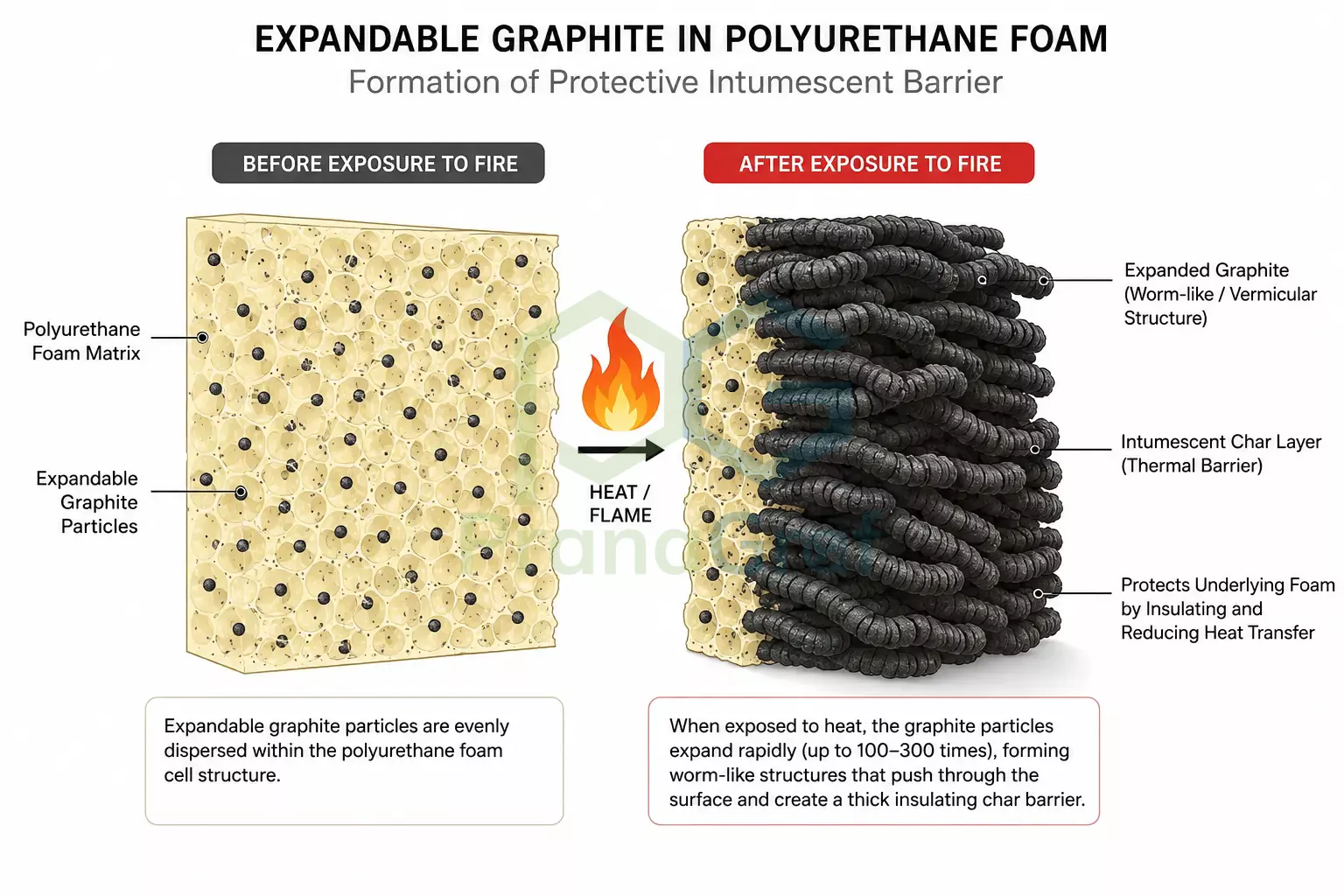
Expandable graphite is manufactured by intercalating natural graphite with chemicals. This gives the graphite the property to expand multifold when exposed to heat. CarboFlameX® expandable graphite forms a vermicular char layer on top of the surface of the foam exposed to heat. This structure creates capillary action with air pockets, making the material insulating to heat. This distributes the heat of the flame and reduces temperature rise in the PU foam. Additionally, the gaps created by the expanded worm structure absorb molten polymer, reducing melt dripping and hotspot creation within the foam. CarboFlameX® expandable products are halogen-free, hence they do not release halogen toxic fumes while retarding fire propagation, reducing the smoke index, toxicity index, and fume generation in case of a fire.
Graphite expansion develops worm-like and exfoliated structures that improve the barrier property of the residual carbon layer, restraining heat and gas exchange from inside the polymer to the outside. Picture a matchstick trying to burn through wet sand — that's roughly the physical logic. The expanded char doesn't just sit there; it actively insulates the unburned foam beneath it.
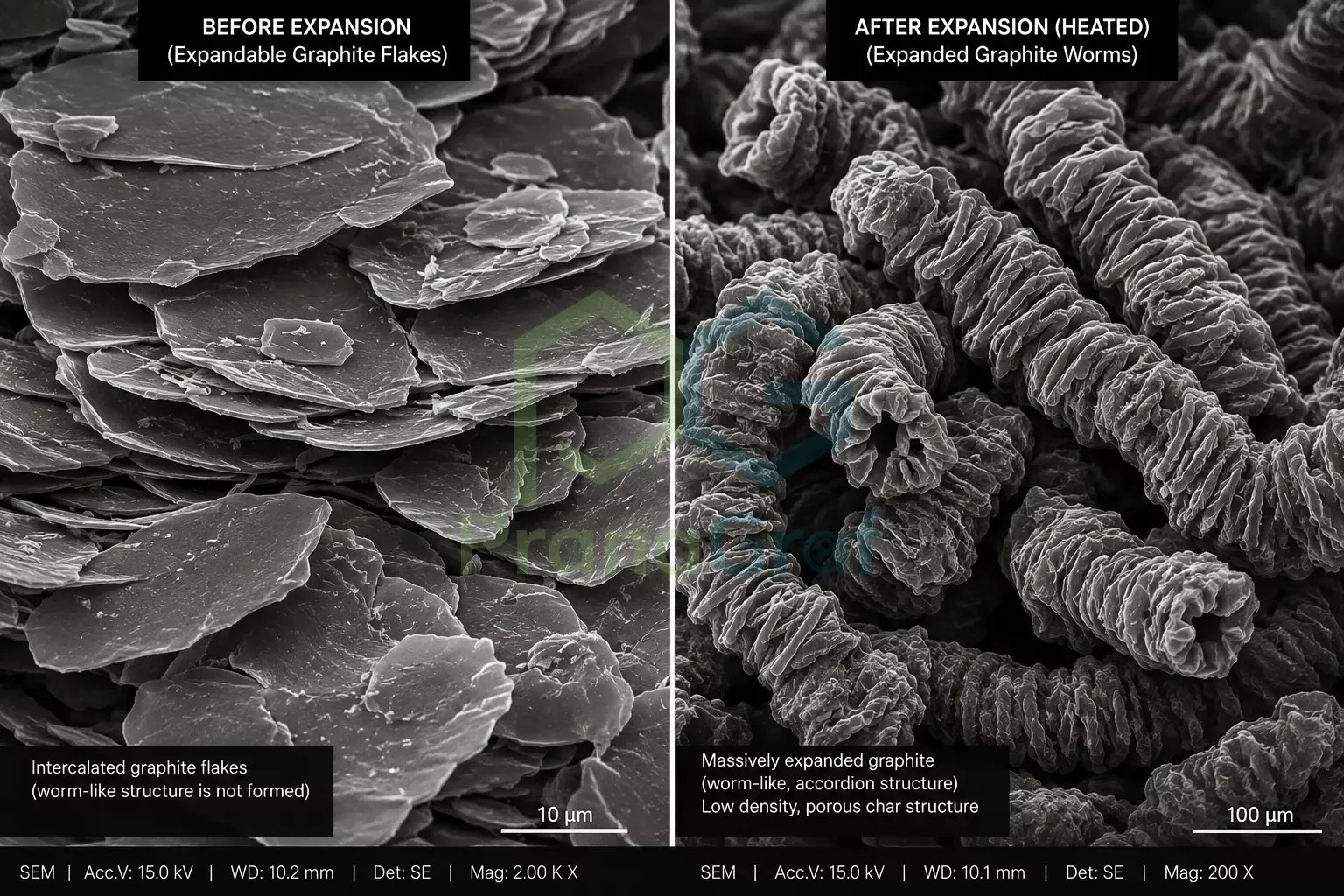
Image: Expandable graphite flakes pre- and post-expansion, showing the worm-like char structure. (Generate using the prompt provided above.)
Why It Matters: A synergistic system combining modified aluminum hydroxide with EG raised the LOI of rigid polyurethane foam by 14.9 units to 34.1%, and increased the 700°C char residue to 1.59 times that of pure foam. That single data point tells you almost everything about why EG shows up in fire-rated insulation formulations.
The MARHE (Maximum Average Rate of Heat Emission) value of PU foams significantly reduces from 40 to below 25 by the addition of CarboFlameX® expandable graphite products.
What Are the Challenges in Processing Expandable Graphite in Polyurethane Foams?
Not all expandable graphite can be used in foam because it is intercalated with acidic intercalants. If the expandable graphite is not processed properly, it can release acidic intercalants and disrupt the cell structure, especially in flexible slabstock foams.
- Expandable graphite can also absorb moisture if not treated properly and cause issues in the foaming reaction.
- It may increase the viscosity of the foam significantly, impacting other properties like resilience, density, and bounciness of a foam.
- It can change the grain size of the cells post-foaming in both flexible and rigid PU foams.
- It can also cause challenges in processing the mixture during the foaming reaction as it needs specialised machinery for dispensing the polyol mixes with expandable graphite.
How Does CarboFlameX® Solve the Challenges of Processing in PU Foams?
CarboFlameX® expandable graphite has been designed using unique technologies where the intercalants are locked inside and sealed, making it difficult for them to release during the process. This reduces the possibility of a foam collapse and makes it compatible with PU foams. PranaGraf manufactures customised grades for both rigid and flexible polyurethane foams to maintain the cell structure. It also reduces corrosion in processing equipment and blockages in dispensers.
Additionally, CarboFlameX® grades for PU foams are designed to reduce the impact on the foam viscosity, maintaining lower viscosity, higher flexibility, and lower density especially in flexible slabstock foams. CarboFlameX® expandable graphite products can be used in continuous slabstock foaming lines as well as batch-produced flexible foams.
PranaGraf also provides guidance on formulations using CarboFlameX® expandable graphite products based on the target flame retardant standards (like BS 5852, EN45545 HL3, ASTM E84, UL94 V0, Euroclass B, etc.). Additionally, PranaGraf has expertise and experience to assist in optimising production processes of foam manufacturing to be able to add expandable graphite.
How Much Expandable Graphite Do You Need in a Foam Formulation?
Loading level is the first question every formulator asks, and the honest answer is: it depends on your target rating. Dosage as low as 15 wt% to up to 45 wt% is used across various grades of CarboFlameX® expandable graphite, with the carbonaceous char layer beneath the foam surface protecting the polymer from flame. Properties like particle size, expansion volume, expansion strength, compatibility with polymer, density of foam, and the requirements of the flame retardant standard matter in choosing the right grade and source of expandable graphite.
Onset temperature is the other lever. Onset or start temperature — the point at which expansion begins — typically falls between 100°C and 300°C, and grades with sizes at or below 350 μm and onset of 160–180°C are considered particularly useful for char consistency. Pick a grade whose onset sits below your foam's likely fire-exposure temperature but above its processing and curing temperature, or you'll get premature expansion during manufacturing.
Rigid or Flexible Foam: Where Does Expandable Graphite Actually Fit?
Rigid foam is EG's natural home, and flexible slabstock is where it struggles. Solid additive flame retardants such as APP, melamine, ATH, or expandable graphite require high loadings to be effective, which increases foam density, stiffens the material, and can disrupt the foaming process — leading to poor cell formation, foam collapse, and uneven rise in continuous slabstock or moulded foam production. CarboFlameX® products solve these issues by locking the intercalants to avoid excessive disturbance in cell structures and foam viscosity.
CarboFlameX® expandable graphite products are actively used in both rigid and flexible foams across various applications from mattresses, refrigeration, automotives, and aircrafts driven by strict fire safety standards and extensive foam use in various applications across these industries.
Where Is the Expandable Graphite Market Headed?
Demand is growing steadily, not explosively, and that's arguably a healthier signal for long-term buyers. The expandable graphite market was valued at $3.75 billion in 2024 and is projected to reach $4.06 billion in 2025 and $8.31 billion by 2034, at a CAGR of roughly 8.29%. A separate volume-based forecast points the same direction: the market is estimated at 88.06 kilotons in 2025 and is expected to reach 127.72 kilotons by 2030, a 7.72% CAGR.
Aerospace, automotive, and electronics are cited as emerging opportunity areas beyond flame retardancy, with EG's lightweight, high-temperature-resistant properties suited to heat shields, thermal insulation, and thermal management applications. For PU foam producers specifically, though, the near-term story stays the same: regulatory displacement of halogenated FRs, not exotic new end uses, is what's pulling volume toward EG.
Frequently Asked Questions
Key Takeaways
Expandable graphite earns its place in rigid PU foam through physics, not chemistry — it builds an intumescent char wall rather than interrupting combustion reactions. The right grade depends on your target rating, your onset-temperature window, and whether you're formulating rigid or flexible foam. With the flame retardant market shifting away from TCPP and other halogenated chemistries, and EG's own market value on track to roughly double by 2034, foam producers who lock in mesh size, onset temperature, and a reliable supply chain now will be better positioned as that shift accelerates.
Sources
Wang et al., Flame Retardancy and Smoke Suppression of Rigid Polyurethane Foam, ChemistrySelect (Wiley), 2025; Structure and Flame-Retardant Actions of Rigid Polyurethane Foams with Expandable Graphite, PMC; Influence of the Characteristics of Expandable Graphite on RPUF, MDPI Polymers; IAL Consultants, Global Overview of Flame Retardants in the Polyurethane Foam Market 2026; Market Research Future, Expandable Graphite Market Report; Mordor Intelligence, Expandable Graphite Market Size & Share; Roots Analysis, Global Expandable Graphite Market Size and Growth; Protective Coatings Patent, USPTO; Spherical Insights, Expandable Graphite Market.

With over 7 years of experience in graphite and graphene technologies, Puruvi leads corporate strategy, global collaborations, and product development across advanced carbon technologies. She has authored multiple technical guides on expandable graphite applications in fire safety and polymer systems.
Related Resources
Ready to optimise your PU foam formulation with CarboFlameX®?
Contact PranaGraf Group today to request samples, discuss specifications, or get formulation guidance for your target fire rating.
Request Technical Consultation