Key Takeaways
- The global expandable graphite market is projected to grow from roughly $0.29 billion in 2025 to $0.42 billion by 2030, a 7.4% CAGR, driven largely by halogen-free flame retardant demand.
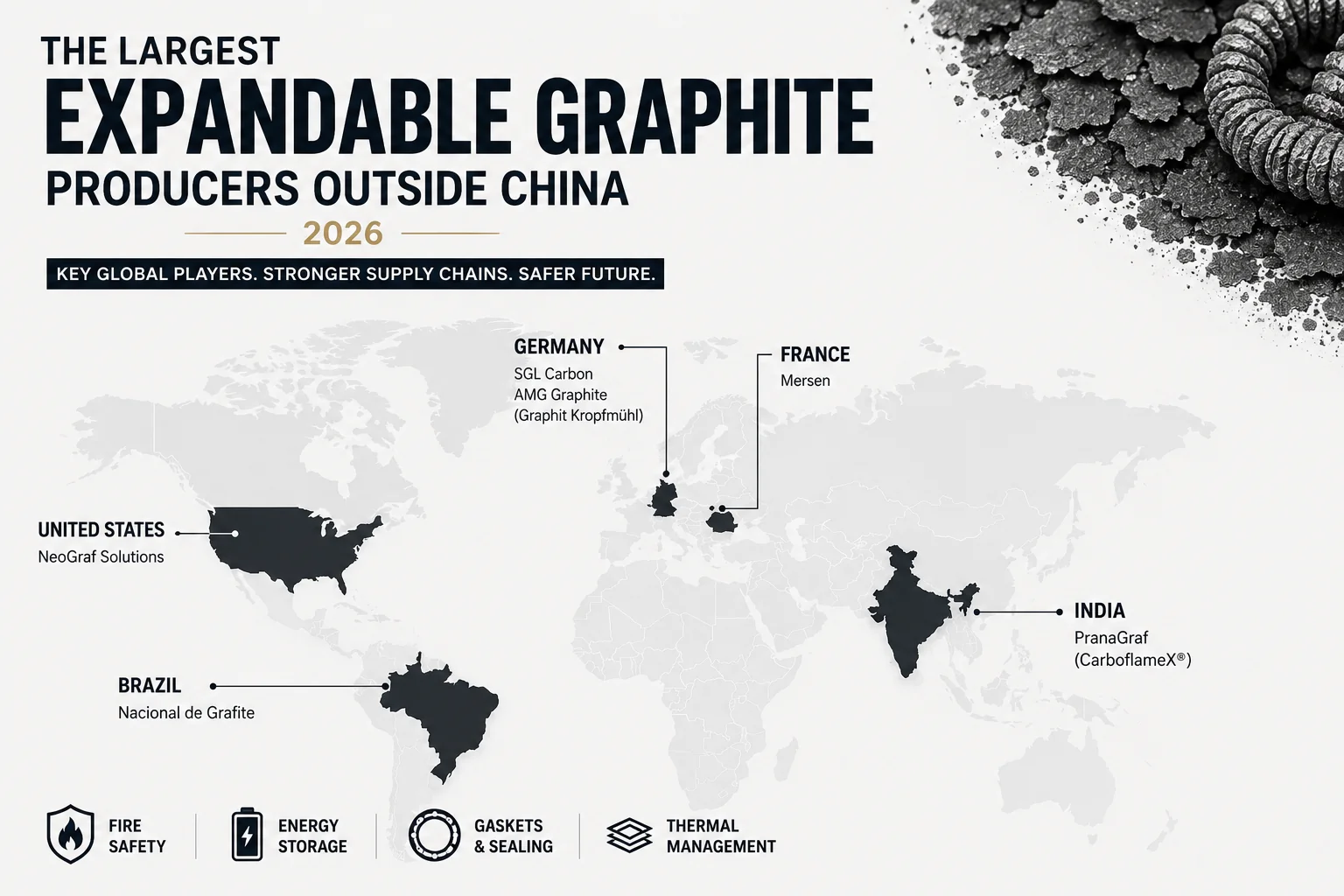
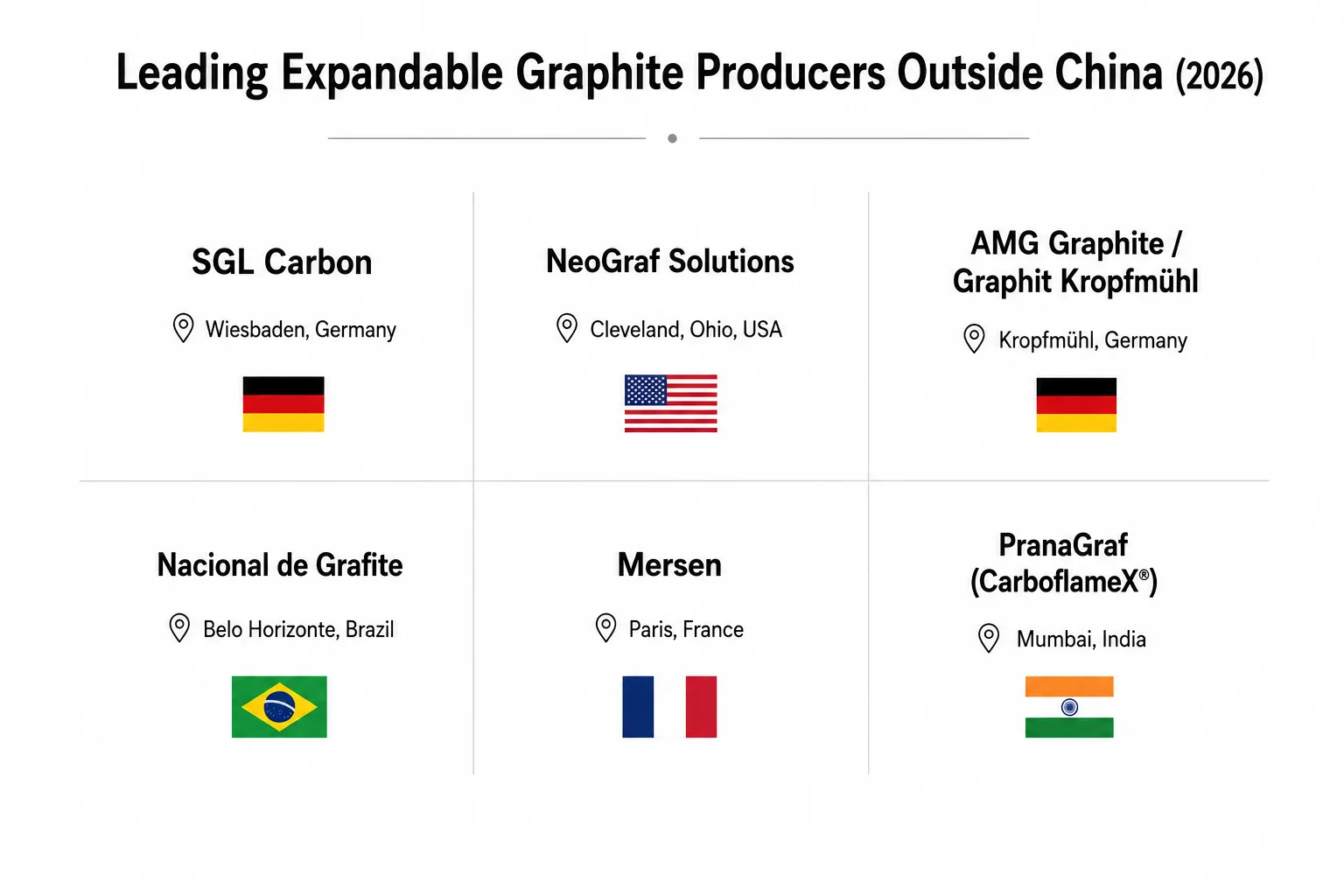
- Established ex-China producers include SGL Carbon (Germany), NeoGraf (US), AMG Graphite/Graphit Kropfmühl (Germany), Nacional de Grafite (Brazil), and Mersen (France).
- PranaGraf, based in Mumbai and Bhubaneswar, India, produces CarboFlameX® expandable graphite using a proprietary zero-hydrofluoric-acid process and Madagascar-origin flake — positioning it as one of the few dedicated ex-China EG specialists outside the legacy European and North American names.
- China still dominates natural graphite mining broadly, but expandable graphite specifically is one of the few graphite product categories where non-Chinese capacity is genuinely competitive on quality, not just volume.
Why "Ex-China" Matters More for Expandable Graphite Than for Bulk Graphite
Expandable graphite isn't raw flake. It's flake graphite that's been intercalated — treated with an expansion agent inserted between the carbon layers so that when the material hits heat, it puffs up dramatically, sometimes to several hundred times its original volume, forming a char layer that starves a fire of oxygen. That intercalation step is a specialty chemistry process, not a mining operation, which means the barrier to entry isn't "who has a graphite deposit" — it's "who has the process control to make a consistent, low-defect expandable product."
That distinction matters for sourcing strategy. A country can have zero natural graphite reserves and still become a serious expandable graphite producer, provided it can import or partner for flake and run the intercalation chemistry well. It also means the ex-China map for expandable graphite looks different from the ex-China map for, say, spherical battery graphite — and buyers evaluating suppliers need to know which list they're actually looking at.
The commercial pressure behind this shift is real. Building codes across the EU and increasingly in North America are pushing away from halogen-based flame retardants toward intumescent systems, and expandable graphite is one of the few materials that performs well in that role without the toxic combustion byproducts regulators are trying to eliminate. Every one of those specification changes is a small, steady tailwind for producers who can supply outside a China-only chain.
The Established Ex-China Names
A short list of companies has carried most of the non-Chinese expandable graphite supply for years. Here's who they are and what actually differentiates each one.
SGL Carbon
SGL Carbon is the name most procurement teams already know, and for good reason — it runs more than 29 sites across Europe, North America, and Asia through business units spanning carbon fibers, composites, and specialty graphite. Expandable graphite sits inside its Graphite Solutions segment, which also covers semiconductor-grade material and flexible graphite foils under the SIGRAFLEX brand. SGL's advantage is breadth: it's less a single-product EG supplier and more a diversified graphite conglomerate where expandable graphite is one line among many.
NeoGraf Solutions
NeoGraf traces its roots back more than 140 years and operates across the Americas, Europe, and Asia through its High-Performance Materials segment. It's best known for flexible graphite products like GrafShield and GrafTherm, used in thermal management and fuel-cell sealing, with expandable graphite as a core input to that flexible-graphite value chain. For US-based buyers wanting domestic sourcing specifically, NeoGraf is usually the first name that comes up.
AMG Graphite / Graphit Kropfmühl
This is one of the more interesting cases because AMG Graphite actually mines its own flake — at its Kropfmühl site in Bavaria and through stakes in Sri Lankan vein graphite mines — rather than relying entirely on third-party feedstock. That vertical integration, running from mine to finished dispersion, has let it develop both chemical and chemical-thermal purification routes in-house. It's also worth noting AMG has been actively working on lowering the carbon footprint of its supply chain, including a renewable-energy agreement with BASF for its Hauzenberg production site.
PranaGraf Materials
PranaGraf Group (previously Tirupati Specialty Graphite) has been manufacturing and supplying expandable graphite products for about a decade from its facilities in India. PranaGraf is led by a team who are 4th generation in the graphite business. It is one of the largest producers outside China for this specialty product. Additionally, PranaGraf also produces natural graphite, high purity graphite, micronised graphite, graphite sheets and other graphite products, serving as the largest producer of downstream graphite products ex-China in Asia. PranaGraf has developed exclusive processing technologies and manufacturing facilities across the value chain with >20,000 tons current capacity and further expansions underway. It is one of the only companies having developed zero-waste processes for these materials and supplies across the globe with distribution in USA, UK, EU, Japan amongst others.
Nacional de Grafite
Operating three plants near the graphite deposits of Minas Gerais, Nacional de Grafite produces roughly 70,000 tonnes of natural graphite annually across industrial applications, smaller quantities of expandable graphite among them. It's the clearest example of a Latin American producer with genuine scale, and it matters strategically because it gives buyers in the Americas a supply option that isn't routed through Europe or Asia at all.
Mersen
Mersen's expandable and flexible graphite business runs under the PAPYEX brand, aimed squarely at chemically aggressive, high-temperature environments — refineries, nuclear facilities, and heavy chemical processing. It's a narrower, more application-specific player than SGL or NeoGraf, but a well-established one in the industries it serves.
PranaGraf: India's Emerging Ex-China Expandable Graphite Specialist
Where the names above have decades — in some cases over a century — of institutional history, PranaGraf represents a newer, more concentrated bet: a specialty downstream graphite company built specifically around the ex-China supply gap, rather than a legacy industrial group that happens to also make expandable graphite.
PranaGraf runs its production and R&D out of two Indian sites — Mumbai and Bhubaneswar — and sources its flake from exclusive partnerships with African mining operations, with Madagascar-grade material forming a core part of its feedstock. That sourcing choice is deliberate. Diversifying the mine-to-product chain away from Chinese flake, not just Chinese processing, is exactly the kind of full-chain independence that halogen-free flame retardant buyers and battery-supply-chain auditors are increasingly asking suppliers to demonstrate.
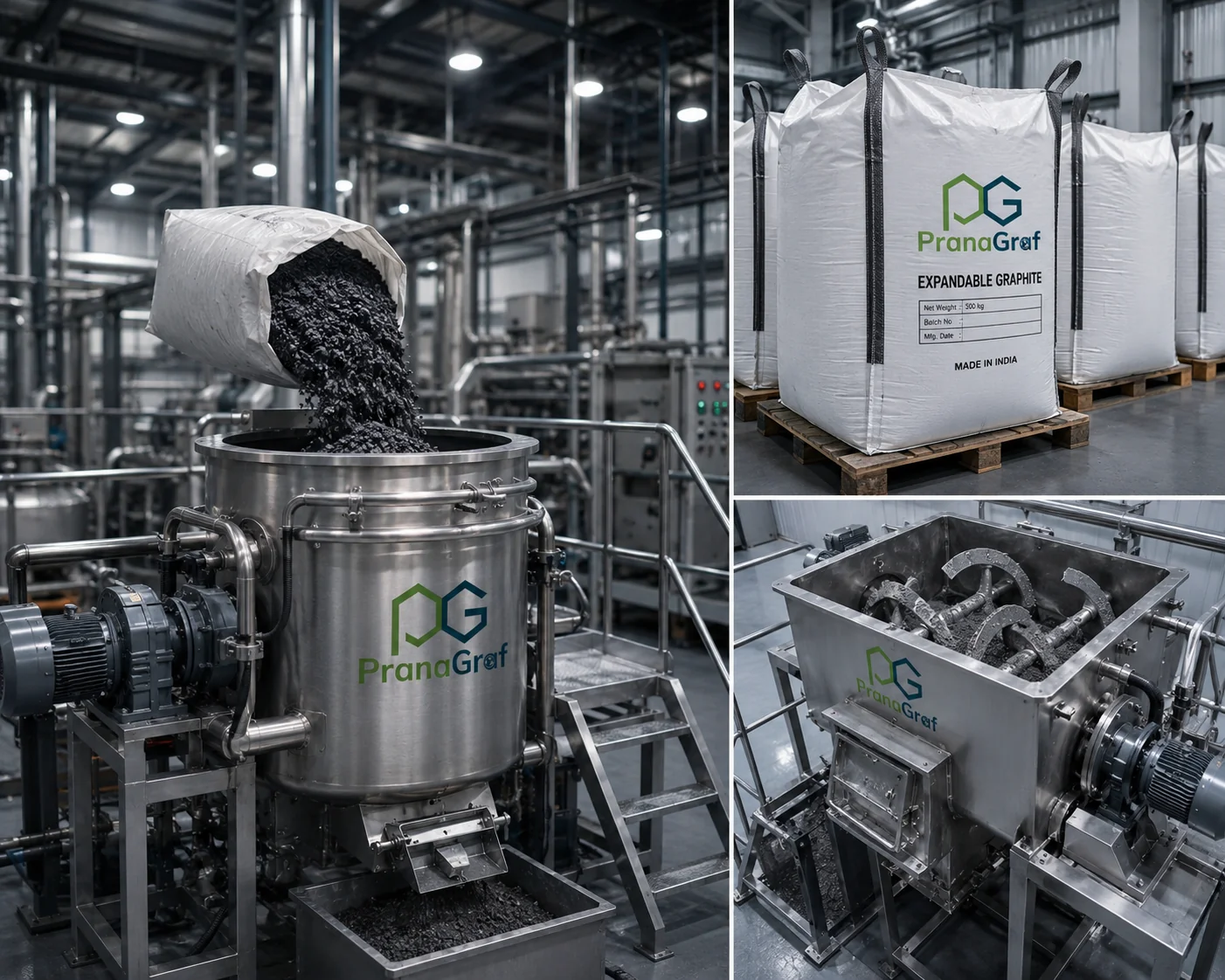
On the technology side, PranaGraf's expandable graphite is sold under its CarboFlameX® brand, and it's produced using what the company describes as a zero-hydrofluoric-acid, zero-waste process — a meaningful detail, since hydrofluoric acid is a common but hazardous reagent in conventional graphite purification, and eliminating it from the process addresses both worker-safety and environmental-discharge concerns that regulators are tightening globally. The company applies a similar zero-HF philosophy across its high-purity graphite line as well, not just expandable graphite.
That's a company still in build-out mode — but one moving in a direction that matters to buyers: expanding capacity specifically for the products (expandable graphite, high-purity graphite, spherical graphite) that ex-China buyers are short on, rather than defending an existing bulk-commodity business.
The broader point PranaGraf's growth illustrates: you don't need 100 years of graphite heritage to become a credible ex-China option. You need controlled feedstock, a defensible process, and the discipline to scale in phases instead of overpromising capacity on day one.
How the Ex-China Field Stacks Up
| Producer | Headquarters | Flake Source | Notable Differentiator |
|---|---|---|---|
| SGL Carbon | Germany | Mixed / global sourcing | Broadest product range, 29+ global sites |
| NeoGraf Solutions | United States | Mixed / global sourcing | 140+ years, strong in flexible graphite for fuel cells |
| AMG Graphite (Kropfmühl) | Germany | Own mines (Germany, Sri Lanka) | Fully vertically integrated, mine-to-product |
| Nacional de Grafite | Brazil | Own mines (Minas Gerais) | Only major Latin American-scale producer |
| Mersen | France | Mixed / global sourcing | Focused on extreme-environment (nuclear, chemical) applications |
| PranaGraf | India | Exclusive African partnerships | Zero-waste, zero-chrome process; purpose-built for ex-China supply, fully integrated, 4 generations of experience |
What This Means If You're Sourcing Expandable Graphite Today
If your only criterion is lowest landed cost per kilogram, Chinese suppliers will likely still win that comparison for a while — scale and decades of process optimization are hard to out-price. But cost per kilogram was never the whole story for expandable graphite buyers, especially in fire-safety and battery applications, where a supply disruption or a failed compliance audit costs far more than the material savings ever delivered. Chinese products can have disadvantages like containing hexavalent chrome, being hygroscopic in nature, causing faster equipment corrosion, and not being optimised for the application, among others.
What's actually changed is optionality. Ten years ago, "ex-China expandable graphite" meant a short list of legacy European and North American names, most of them treating EG as one product line among dozens. Today that list includes producers built specifically around closing the ex-China gap — with cleaner processes, controlled African flake sourcing, and capacity additions timed to exactly the applications driving demand growth: halogen-free construction codes, EV thermal and gasket components, and energy-storage systems. PranaGraf additionally also helps with compatibility of its products in your process and application, giving various advantages in production efficiency and product performance.
Is any single ex-China producer going to replace Chinese supply at scale in the next few years? No — and nobody serious is claiming that. But a diversified sourcing strategy across two or three of these producers, rather than a single-country dependency, is quickly becoming standard procurement practice rather than a hedge.
Frequently Asked Questions
Sources
MarketsandMarkets, Expandable Graphite Market Report; SGL Carbon; NeoGraf Solutions/CB Insights; AMG Graphite (Graphit Kropfmühl); Nacional de Grafite; Mersen; PranaGraf Group.

With over 7 years of experience in graphite and graphene technologies, Puruvi leads corporate strategy, global collaborations, and product development across advanced carbon technologies. She has authored multiple technical guides on expandable graphite applications in fire safety and polymer systems.
Related Resources
Looking to diversify your expandable graphite supply chain?
Contact PranaGraf Group today to request CarboFlameX® samples, discuss specifications, or evaluate ex-China supply options.
Request Technical Consultation