Key Takeaways
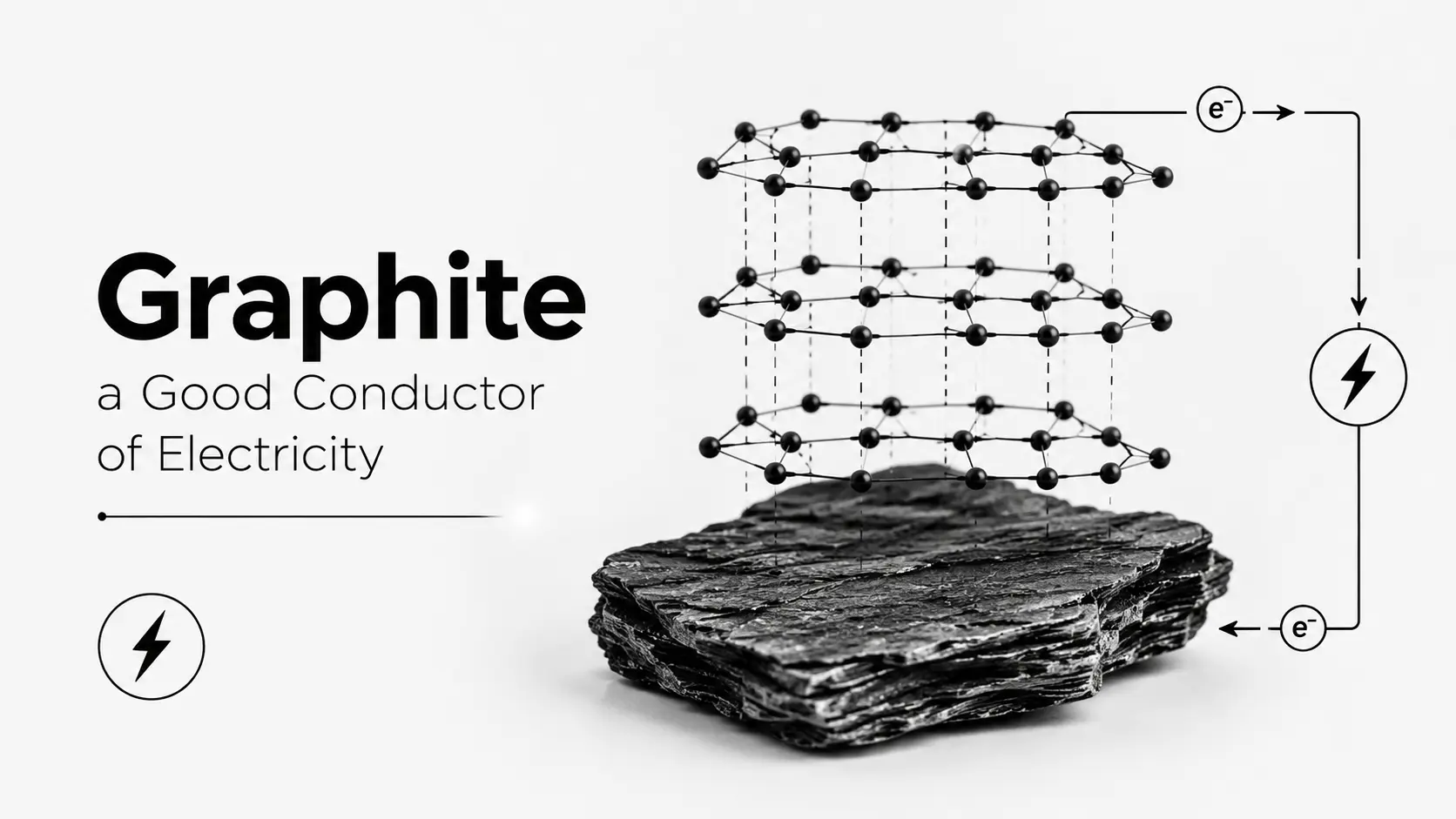
- Graphite conducts because each carbon atom leaves one electron delocalized across a 2D sheet, unlike diamond, where all four electrons are locked in place.
- Conductivity is directional (anisotropic): current flows roughly 1,000 times better along graphite's layers than across them (ScienceDirect Topics).
- Electric arc furnaces drive most demand — EAF steelmaking pulls in roughly 65-78% of graphite electrode demand depending on the market study (Reanin; Research Nester).
- The global graphite electrode market is on track to grow from about $9.3 billion in 2025 to $14.5 billion by 2032, a 6.5% CAGR (Reanin).
- Ultra-high-power (UHP) grades, prized for lower resistance and longer service life, already hold roughly half the market (Mordor Intelligence).
What Makes Graphite Different From Other Forms of Carbon?
Graphite is carbon, but so is diamond, and diamond is one of the best electrical insulators known. The difference isn't the element — it's the architecture. Each carbon atom in graphite bonds to only three neighbors, arranged flat in interlocking hexagons that stack into sheets called graphene layers, with the fourth bonding electron left over for conduction (RevisionDojo).
Diamond takes the opposite approach. Every carbon atom there forms four strong bonds in a rigid 3D cage, so none of its electrons are free to move — which is exactly why diamond, despite being pure carbon, does not conduct current (Wikipedia, "Delocalized Electron"). Same element, opposite electrical behavior, purely because of how the atoms are wired together.
That one-bond difference is the whole story. Graphite's flat sheets stack loosely on top of one another, held together by weak van der Waals forces rather than strong covalent bonds. It's why pencil "lead" rubs off onto paper so easily, and it's also the mechanical trade-off manufacturers accept in exchange for conductivity: graphite is soft and slippery precisely because those layers can slide.
How Do Delocalized Electrons Actually Create Conductivity?
Every carbon atom in a graphite sheet has four valence electrons, but only three get used to bond with its neighbors. The fourth doesn't sit idle. It drops into a p-orbital that overlaps with the p-orbitals of every other atom in the layer, and together they merge into a shared electron cloud spread across the entire sheet (Kintek Solution). Apply a voltage across that sheet, and the electron cloud shifts in response, much like it would in a metal wire.
Why does this matter more than it sounds? Because it's the mechanism, not just the label, that determines performance. As ring systems of carbon atoms grow larger, the available energy levels multiply and pack closer together, so it takes very little extra energy to push an electron into a conducting state (ScienceDirect Topics) — which is exactly why graphite conducts so readily compared with smaller aromatic molecules.
Why Does Graphite Conduct Better in One Direction Than Another?
Graphite's conductivity isn't uniform, and this trips up buyers who assume "conductive material" means conductive in every direction. It doesn't. This directional behavior is called anisotropy, and it comes straight from the bonding structure described above.
Within a single graphene layer, delocalized electrons move fast and freely. Between layers, there's no such highway, since the layers are only held together by weak van der Waals forces rather than chemical bonds, so electrons can't easily jump from one sheet to the next (Kintek Solution). The practical result: conductivity in-plane can run roughly 1,000 times higher than conductivity perpendicular to the layers, per the ScienceDirect Topics figures cited above.
For engineers, this isn't academic. It's why electrode geometry, grain orientation, and grade selection all get specified carefully — current has to be steered along the "easy" direction to get graphite's conductivity to pay off in a real furnace or contact.
Graphite is available in a powder form and hence when mixed with a base material, the particles are oriented in various directions imparting an overall thermal and electrical conductivity to the product based on the dosage used.
Where Manufacturers Actually Use Graphite's Conductivity
Graphite's conductivity would be a lab curiosity if it didn't hold up at industrial scale, high temperature, and repeated thermal cycling. It does, and that's why it shows up across heavy industry, not just pencils.
Natural Graphite is used in applications like:
- Refractories & Crucibles: Graphite conducts the heat in the vessels where molten metal flows providing the ability to hold metals at such high temperatures.
- In Plastics: Natural graphite particles are dispersed in polymer matrices to improve the thermal and electrical conductivity in various plastics up to the conductivity range of resistance.
Synthetic graphite is majorly used in:
- Electric arc furnace (EAF) steelmaking is the biggest single use case. Graphite electrodes carry the current that strikes and sustains the arc that melts scrap steel. Industry researcher Reanin attributes close to 65% of graphite electrode demand to EAF operations, citing the material's heat tolerance and conductivity as the reason it has become hard to replace in industrial production. Other market studies put EAF's share of total electrode application demand even higher, near 70-78% of the market (Research Nester).
- Ultra-high-power (UHP) electrodes are the premium tier built for the biggest, hottest furnaces. Mordor Intelligence estimates that UHP grades tolerate higher currents, cut power consumption by roughly 18%, and last about 25% longer than standard high-power electrodes, which lowers the total cost per ton of finished steel even at a higher purchase price. That performance gap is why UHP already commands roughly half the market by volume.
Beyond electrodes, graphite's conductivity — combined with its stability and low friction — makes it the default choice for electrical brushes in motors and generators, EDM (electrical discharge machining) tooling, battery anodes, and conductive coatings for equipment that needs a controlled path to ground. Graphite is a core material in lithium-ion battery anodes, and rising EV sales are pushing demand for higher-quality graphite feedstock.
Graphite vs. Copper vs. Diamond: A Quick Comparison
| Property | Graphite | Copper | Diamond |
|---|---|---|---|
| Conductivity mechanism | Delocalized electrons in 2D sheets | Free electron sea (metal) | None — all electrons locked in covalent bonds |
| Conducts electricity? | Yes, but directional (anisotropic) | Yes, uniformly | No — excellent insulator |
| Max service temperature | Very high (3,000°C+ in electrodes) | Melts around 1,085°C | Very high, but not used for conduction |
| Typical industrial role | Electrodes, brushes, battery anodes | Wiring, windings, busbars | Cutting tools, abrasives, heat spreaders |
| Mechanical behavior | Soft, layers slide (lubricating) | Ductile, malleable | Hardest known natural material |
Copper still wins for uniform, high-conductivity wiring. Graphite wins where you need conductivity plus extreme heat resistance, chemical stability, or a self-lubricating surface — conditions that would melt or corrode copper.
Frequently Asked Questions
Sources
Kintek Solution; RevisionDojo; ScienceDirect Topics; Wikipedia, "Delocalized Electron"; Reanin; Mordor Intelligence; Research Nester; IMARC Group; Congruence Market Insights.

With over 7 years of experience in graphite and graphene technologies, Puruvi leads corporate strategy, global collaborations, and product development across advanced carbon technologies. She has authored multiple technical guides on graphite properties and industrial applications.
Related Resources
Need graphite for your industrial application?
Contact PranaGraf Group today to discuss your grade requirements, request samples, or get technical support.
Request Technical Consultation